
How Binary Options Work: From Opening a Trade to Expiry
How binary options work, step by step: strike price, expiry, payout, ties and early close, with worked examples and the maths behind every trade you place.

A binary option works like this: you choose an asset, predict whether its price will be above or below a reference level (the strike) at a set expiry time, and stake a fixed amount. At expiry, the platform compares the closing price to the strike. If your prediction was correct you receive your stake back plus a fixed percentage profit; if it was wrong you lose the stake.
That is the whole mechanism. The rest of this guide walks through each piece in detail, with numbers, so you know exactly what happens to your money from the moment you click "Higher" or "Lower" to the moment the trade settles. If you are completely new, start with what are binary options.
The life cycle of a single trade
Every standard binary option goes through the same five stages.
- Choose the asset. For example EUR/USD, gold, the S&P 500 or Bitcoin.
- Set the expiry. Either a duration (60 seconds, 5 minutes, 1 hour) or a fixed clock time (14:30).
- Set the stake. The amount you are willing to lose on this trade.
- Choose the direction. "Call" or "Higher" if you expect the price to finish above the strike; "Put" or "Lower" if you expect it to finish below.
- Settlement. At expiry the platform reads the closing price and pays out or closes the trade at a loss.
Before you confirm, the platform shows the payout percentage. That number, together with your stake, tells you the exact profit if you win. The loss if you are wrong is always the stake.
The strike price
On most OTC platforms the strike is simply the market price at the moment you open the trade. If you buy a "Higher" option on gold at $2,350.40, the question becomes: will gold be above $2,350.40 at expiry?
On exchanges and on some platforms, strikes are fixed levels set in advance, for example "Will the US 500 be above 5,600 at 16:00?". These options are priced according to how likely the outcome is, which is covered in types of binary options.
Expiry: how the outcome is decided
Expiry is the exact moment at which the result is measured. What happens before then does not matter for a standard high/low option. The price can go deep against you for four minutes and then finish one tick in your favour, and the trade wins. The reverse is also true.
That makes expiry choice one of the most important decisions you make. Very short expiries (under a minute) are dominated by random price noise. Longer expiries give an analytical idea more time to play out but also expose you to news and volatility. We cover the trade-offs in how to choose expiry time.
Tip: Check which price your broker uses at expiry. Most use the last quoted price at the expiry second. If prices on your chart and the settlement price ever disagree, take a screenshot and raise it with support.
Payouts and what they really cost you
The payout percentage is the profit you make on a winning trade, expressed as a share of your stake. It is set by the broker and varies with the asset, the expiry, the time of day and sometimes your account level. Typical OTC payouts sit somewhere around 70–92%.
Worked example: one trade
You stake $100 on "EUR/USD Higher", 15-minute expiry, payout 85%.
| Outcome | Price at expiry vs strike | You receive | Net result |
|---|---|---|---|
| Win | Above | $185 | +$85 |
| Tie | Exactly equal | $100 (stake refunded, on most platforms) | $0 |
| Loss | Below | $0 | −$100 |
Worked example: 100 trades
Now imagine you place 100 identical $100 trades at an 85% payout and win 55 of them.
- Profit from wins: 55 × $85 = $4,675
- Loss from losses: 45 × $100 = $4,500
- Net: +$175
Drop your win rate to 53%:
- Wins: 53 × $85 = $4,505
- Losses: 47 × $100 = $4,700
- Net: −$195
A two-percentage-point difference in accuracy turned a small profit into a loss. The exact line between profit and loss at an 85% payout is 1 ÷ 1.85 ≈ 54.1%. You can calculate this for any payout with the break-even calculator, or estimate your expected result per trade with the expected value calculator.
Risk warning: Every binary option has a negative expected value at a 50% win rate. You only come out ahead if your real, sustained accuracy is above the break-even level. Most retail traders do not achieve that.
Who is on the other side of your trade
This depends on where you trade.
OTC brokers
With most online binary options brokers, the broker is your counterparty. It sets the price feed, the payout and the settlement rules. Your loss is the broker's revenue. That is a structural conflict of interest, and it is the reason broker selection, regulation and reputation matter so much. Read how to choose a binary options broker and binary options scams: red flags before you deposit anywhere.
Exchanges
On a regulated exchange, binary contracts are priced between $0 and $100 (or a similar fixed range) and trade between buyers and sellers. A contract priced at $40 reflects a market view that the event has roughly a 40% chance of happening. If the event happens, the contract settles at $100; if it does not, it settles at $0. Your maximum loss is what you paid, and your maximum profit is $100 minus what you paid. The exchange charges a fee per contract instead of building its margin into a payout percentage.
Example: You buy one exchange-traded binary at $40 that pays $100 if gold closes above $2,400 today. If it does, you make $60 (minus fees). If it does not, you lose $40. Selling the same contract means you collect $40 and risk $60.
Closing early and other platform features
Standard OTC binary options run to expiry. Some platforms add extra features:
- Early close / sell back. The platform offers to buy your option back before expiry at a price it calculates. If the trade is currently winning, you get less than the full payout; if it is losing, you recover part of your stake.
- Rollover / extend. Push the expiry further out, usually for an extra fee or a reduced payout.
- Double up. Open a second identical trade at the current price, increasing exposure.
- Tie rules. Most platforms refund the stake on an exact tie; some count it as a loss. Read the terms.
On exchanges, you can generally sell a contract before expiry at the current market price, which depends on how likely the outcome now looks.
Why the payout changes
The payout you see is not fixed across the platform. It tends to drop when:
- the market is very volatile or around major news releases,
- liquidity is thin, such as weekends on synthetic "OTC" assets,
- the expiry is very short,
- many traders are taking the same side.
Lower payouts raise your break-even win rate. A trade at 70% needs a 58.8% win rate to break even, compared with 52.6% at 90%. It is worth checking the payout every time rather than assuming it.
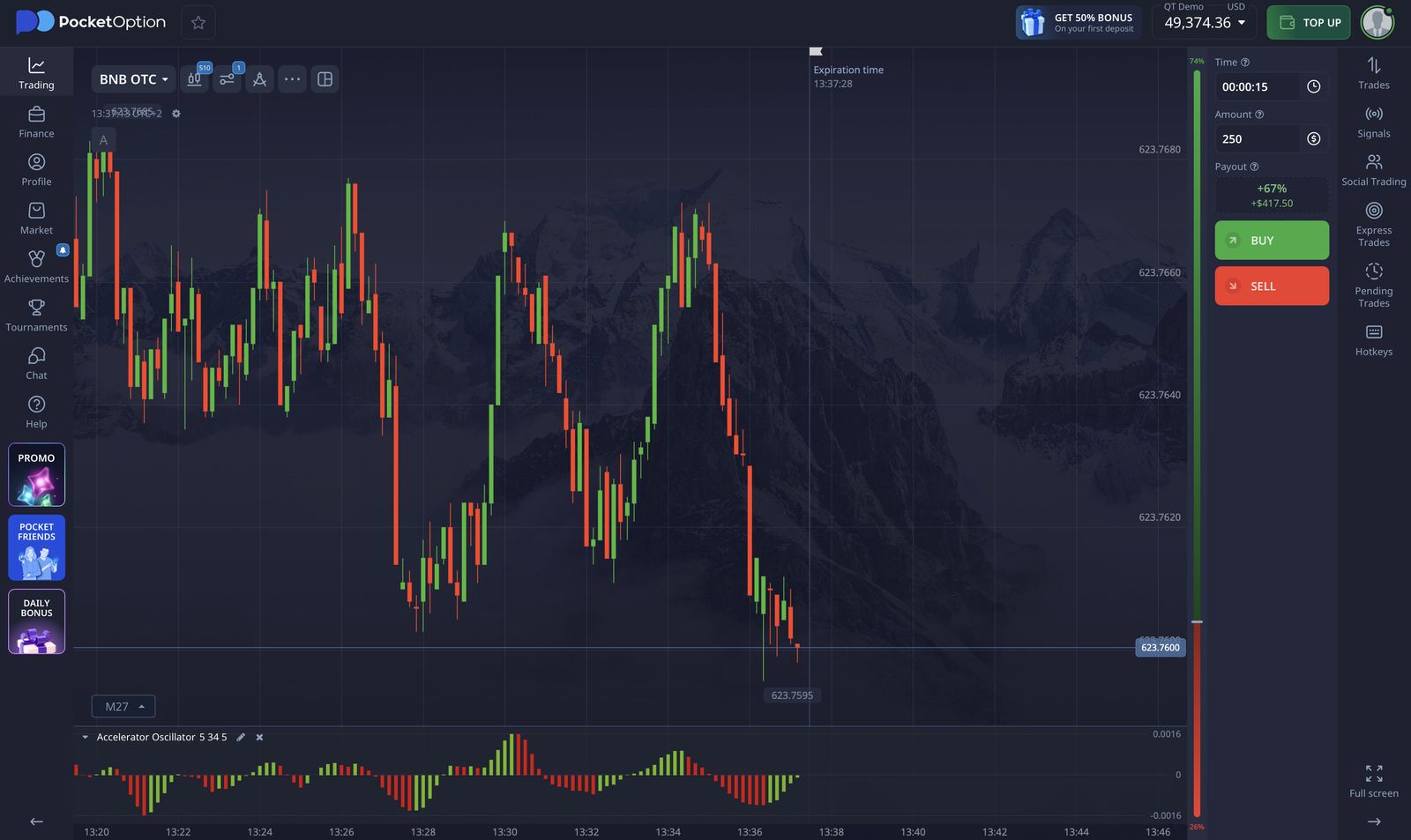
What a trading platform screen shows
Although layouts differ, most platforms show the same set of information:
| Element | What it tells you |
|---|---|
| Price chart | The live price of the asset, with selectable timeframes and indicators |
| Asset selector | The list of tradable markets and their current payouts |
| Expiry selector | Duration or clock time for the trade |
| Amount field | Your stake |
| Payout display | Profit percentage and the amount you would receive |
| Higher / Lower buttons | Opens the trade in your chosen direction |
| Open trades panel | Countdown to expiry and current status of each trade |
Platforms such as Pocket Option offer a demo account with virtual funds, which is the right place to learn the interface. Our guide on how to use a demo account explains how to practise in a way that gives you useful information.
Position size: how much to stake
Because each trade can lose 100% of the stake, position size decides how long you can survive a losing streak. Many experienced traders risk 1–2% of their account per trade. With a $1,000 account, 2% means $20 per trade.
At that size, ten losses in a row costs about $180 (each loss reduces the base for the next 2%). At 10% per trade, the same streak would wipe out roughly two thirds of the account. Losing streaks of that length happen more often than most beginners expect, even with a decent win rate. Use the position size calculator and the risk of ruin calculator to see how stake size affects survival. The principles are covered in money management basics.
FAQ
Do I need to own the asset?
No. You never own the underlying currency, stock or coin. A binary option is a contract on the price only.
Can I lose more than my stake?
With standard binary options, no. Your maximum loss on each trade is the amount you staked.
Is the result decided by the closing price or by any touch during the trade?
For standard high/low options, only the price at expiry counts. Touch and boundary options use different rules; see types of binary options.
Why did my trade lose when the chart looks like it won?
Usually the price was very close to the strike, and a small difference in the settlement price, chart timeframe or tick timing decided the outcome. If you suspect an error, ask the broker for the exact strike and settlement prices.
Key takeaways
- You choose asset, expiry, stake and direction; the result is decided only by the price at expiry relative to the strike.
- A win pays a fixed percentage of your stake, a loss costs the full stake, so you need a win rate above roughly 52–56% to break even.
- With OTC brokers the broker is your counterparty; on exchanges you trade against other participants and pay a fee.
- Payouts change with volatility, expiry and time of day, so check them before every trade.
- Keep stakes small relative to your account, because losing streaks are normal.

Recommended broker
Practise this on a free Pocket Option demo
Free demo account, $1 minimum trade and payouts up to 92%. Test everything with virtual money first.
Binary options are high risk and not available in every country. Check the legal status where you live.
Next in Binary Options Basics
Types of Binary Options: High/Low, Touch, Range and More
This guide is for educational purposes only and is not financial advice. Binary options are high risk and banned for retail clients in many countries. See our risk disclaimer.
Keep learning
What Are Binary Options? A Plain-English Introduction
What are binary options? A clear explanation of how this yes-or-no trade works, how payouts are set, what you can lose and why the odds favour the broker.
8 min read · 1 Aug 2026Binary Options BasicsTypes of Binary Options: High/Low, Touch, Range and More
The main types of binary options explained: high/low, touch and no-touch, range, ladder, turbo and exchange-traded binaries, with payouts, examples and risks.
8 min read · 3 Aug 2026Binary Options BasicsBinary Options vs Forex and CFDs: Key Differences Explained
Binary options vs forex and CFDs compared: how profit and loss are calculated, leverage, costs, regulation and risk, with side-by-side worked examples.
8 min read · 26 Aug 2026