
How to Use a Binary Options Demo Account (So the Practice Actually Counts)
How to use a binary options demo account properly: set a realistic balance, trade written rules, log 100+ trades and judge results against break-even.

A binary options demo account lets you trade live prices with virtual money, and you use it well by treating it like a real account: set a realistic balance, follow written entry rules, use the stake size you plan to use with real money, and log every trade until you have a sample of at least 100. Used that way, a demo answers one question honestly: do your rules beat the break-even win rate? Used as a game, it teaches habits that cost money later.
What a demo account is (and is not)
A demo account mirrors the broker's real trading platform. You see the same assets, chart tools, expiry options and, in most cases, the same payout percentages, but your balance is virtual and nothing is at stake.
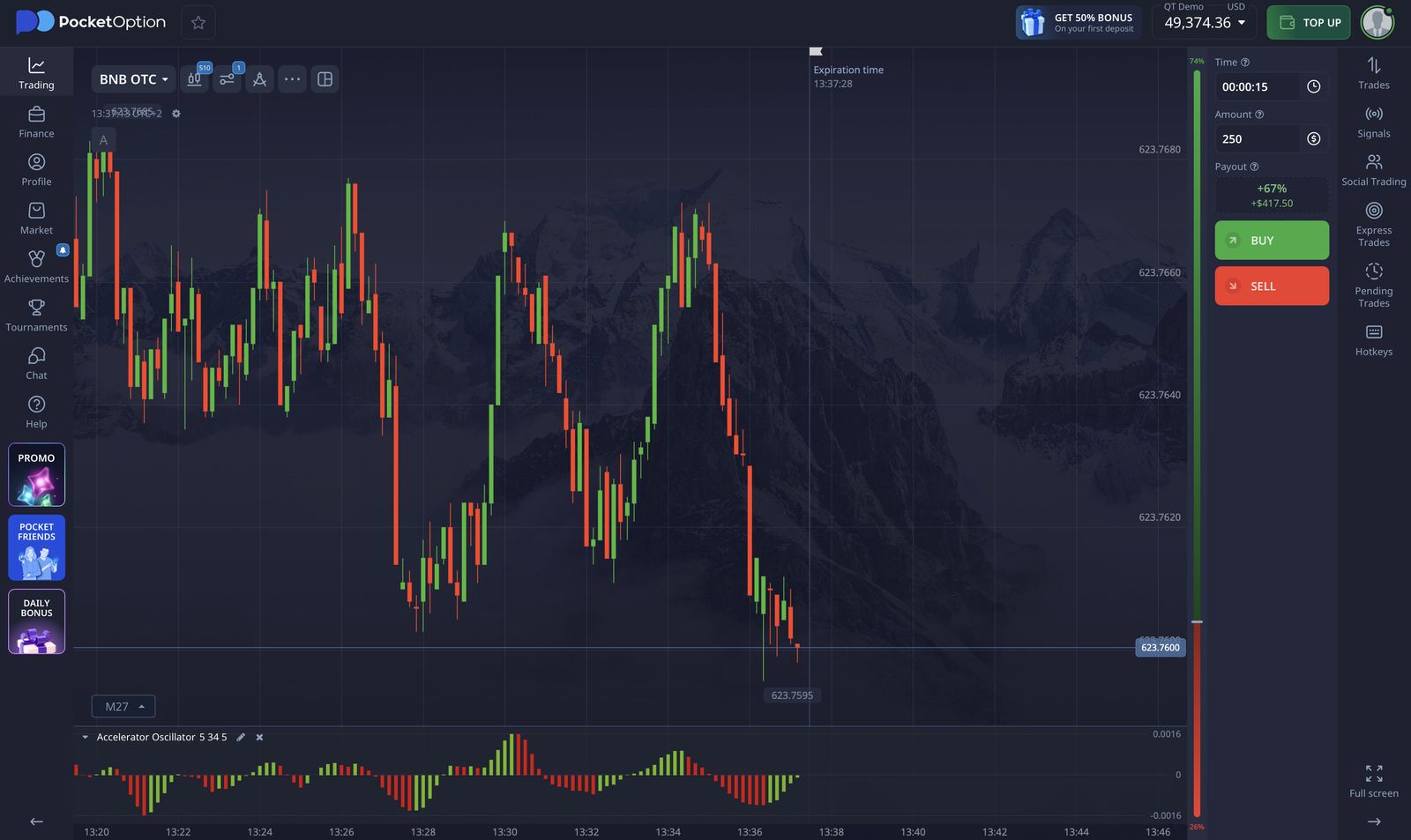
What a demo can do:
- Teach you the platform: order buttons, expiry selection, chart settings, trade history.
- Test whether a defined set of rules has an edge over a meaningful number of trades.
- Let you practise routines such as pre-trade checklists, journaling and daily stop rules.
What a demo cannot do:
- Reproduce the emotional pressure of losing real money.
- Prove a strategy will work in the future. It only shows how rules performed in the period you tested.
- Fully guarantee identical conditions. Execution, available assets or payouts can differ between demo and live accounts at some brokers, so check this before relying on the numbers.
Step 1: Pick a broker demo that matches what you will trade live
Practise on the same platform you expect to use for real money. Payouts, asset lists and expiry options differ between brokers, and a strategy tested at a 90% payout behaves differently at 80%.
Some brokers let you open a demo without depositing, and a few let you start without registering at all. Pocket Option, for example, offers a demo mode with a virtual balance you can top up. Whatever platform you use, confirm the demo shows the same payouts you would get on a live account for your chosen assets and trading hours.
Tip: If you have not chosen a broker yet, read how to choose a binary options broker first, so you do not build habits on a platform you will never trade with.
Step 2: Set a realistic balance
Demo accounts often start with a large virtual balance. That is a trap. If you plan to deposit $200, a $10,000 practice balance makes $50 stakes feel trivial, and you will learn sizing habits you cannot afford later.
Two ways to fix this:
- Track a "shadow" balance. Write down your planned real deposit (say $200) and calculate every stake from that figure, ignoring the larger number on screen.
- Reset or adjust the balance if the platform allows it.
Example: Your planned deposit is $250 and you risk 2% per trade. Your demo stake should be $5, not 2% of a $10,000 virtual balance ($200).
Step 3: Write your rules before the first trade
A demo session without rules produces a pile of random results you cannot learn from. Write a one-page plan that covers:
| Rule | Example |
|---|---|
| Asset | EUR/USD only |
| Chart time frame | 5-minute candles |
| Expiry | 15 minutes (three candles) |
| Entry condition | Price touches a marked support level and RSI(14) is below 30 |
| Direction | Call (up) only at support, put (down) only at resistance |
| Stake | 2% of shadow balance |
| Session limits | Max 6 trades, stop after 3 losses |
The specific rules are up to you. What matters is that someone else could read your plan and take the same trades. Our guide to building a trading plan goes deeper, and how to choose expiry time helps you match expiry to your chart.
Step 4: Trade the plan and log everything
Each trade gets a journal line recorded right after you open it, before you know the result:
- Date, time and asset
- Direction and expiry
- Payout percentage offered
- Stake
- The setup that triggered the trade (which rule)
- A screenshot of the chart at entry
- Result and profit/loss once it closes
Also record trades you wanted to take but skipped, and trades you took that broke your rules. Rule breaks are the most useful data you will collect on demo, because they show you where your discipline will fail on a real account. See how to keep a trading journal for a full template.
Step 5: Collect enough trades to mean something
Small samples lie. A coin-flip strategy can easily win 7 out of 10 trades by chance. Here is why sample size matters, using basic probability:
Example: Suppose your true win rate is exactly 50% (no edge). Over 20 trades, the standard deviation of your observed win rate is about √(0.5 × 0.5 ÷ 20) ≈ 11 percentage points, so seeing 60% or more is quite plausible. Over 100 trades, it shrinks to about 5 points. Over 400 trades, about 2.5 points.
That is why a practical minimum is around 100 trades under the same rules, and more is better. If you change your rules, start a new count.
Step 6: Judge results against break-even, not against zero
Winning more than half your trades is not enough. Because a binary option pays less on a win (for example 85%) than it costs on a loss (100%), you need a win rate above the break-even level:
Break-even win rate = 1 ÷ (1 + payout)
| Average payout | Break-even win rate |
|---|---|
| 80% | 55.6% |
| 85% | 54.1% |
| 90% | 52.6% |
Example: After 120 demo trades at an average 85% payout, you won 68. Your win rate is 68 ÷ 120 = 56.7%. Net result per $10 stake: 68 × $8.50 – 52 × $10 = $578 – $520 = +$58. That is above break-even, but only by about 2.6 percentage points, so a small drop in performance on a live account would erase the edge.
Check your own figures with the break-even calculator and the expected value calculator.
Step 7: Decide what happens next
At the end of your test, one of three things is true:
- Clearly above break-even over 100+ trades, with rules followed consistently. You can consider a small live account with the same rules and stakes.
- Around break-even. Your rules do not show a reliable edge. Refine one element (for example, the entry filter or trading hours) and test again.
- Below break-even. Treat this as useful information. The demo just saved you real money.
Common demo mistakes
Oversized stakes
Betting 20% of a virtual balance because "it isn't real" trains exactly the behaviour that destroys real accounts.
Resetting after losses
If you reset the balance every time it drops, you never experience drawdown, and you learn nothing about how to handle it. Keep the history intact.
Testing martingale on demo and calling it a success
Doubling up after losses can look profitable for a while on demo, then wipe the account in a single losing streak. A short demo run is often too brief to show that streak. Use the martingale simulator to see the long-run outcome, and read why martingale fails.
Staying on demo forever, or leaving too soon
Some traders never move on because demo feels safe; others jump to real money after a lucky week. Define your exit criteria in advance: a minimum number of trades, a minimum win rate above break-even, and a record of following your rules.
Ignoring the emotional gap
Your demo results are a best case. With real money, hesitation, early exits and revenge trades creep in. Expect your live results to be somewhat worse, and keep your first live stakes as small as the platform allows.
Moving from demo to live
When you do switch:
- Keep the same asset, expiry, entry rule and stake percentage.
- Start with the smallest deposit you are comfortable losing.
- Keep journaling, and add a note on how you felt during each trade.
- Compare live and demo stats after 50 live trades. A big gap usually points to discipline, not strategy.
Risk warning: A profitable demo period does not guarantee profits with real money. Binary options are high risk, and most retail traders lose money. Check the legal status in your country before depositing.
FAQ
Is a binary options demo account free?
Demo accounts at most binary options brokers are free and use virtual funds. Some require registration and others let you try the platform immediately.
How long should I trade on a demo account?
Long enough to log at least 100 trades under one fixed set of rules. For most people that means several weeks of regular sessions, not a single afternoon.
Are demo results the same as real results?
Prices are usually the same, but your behaviour will not be. Real money adds pressure that affects decisions, so treat demo performance as an upper limit.
Can I make money on a demo account?
No. Demo profits are virtual and cannot be withdrawn. Any site promising real cash from demo trading is a red flag. See binary options scams and red flags.
Key takeaways
- Use a demo on the same platform and payouts you plan to trade live.
- Base stakes on your planned real deposit, not the large virtual balance.
- Write your rules first, then log every trade, including rule breaks.
- Judge results over 100+ trades against the break-even win rate for your payout.
- Expect live results to be worse than demo, and start live with minimum stakes.

Recommended broker
Practise this on a free Pocket Option demo
Free demo account, $1 minimum trade and payouts up to 92%. Test everything with virtual money first.
Binary options are high risk and not available in every country. Check the legal status where you live.
Next in Practical Guides
How to Choose Expiry Time in Binary Options
This guide is for educational purposes only and is not financial advice. Binary options are high risk and banned for retail clients in many countries. See our risk disclaimer.
Keep learning
How to Start Trading Binary Options: A Step-by-Step Plan for Beginners
How to start trading binary options step by step: check legality, learn the payout math, practise on demo, pick a broker and size your first real trades.
8 min read · 6 Aug 2026Practical GuidesHow to Choose Expiry Time in Binary Options
How to choose expiry time in binary options: match expiry to your chart time frame and setup, avoid ultra-short trades and test choices on a demo first.
7 min read · 23 Aug 2026Practical GuidesHow to Choose a Binary Options Broker: A Practical Checklist
How to choose a binary options broker: check legal status, regulation, withdrawal terms, payouts, bonus conditions and platform quality before you deposit.
7 min read · 9 Sept 2026