
Short-Expiry Binary Options: The Truth About 5-Second, 30-Second and 1-Minute Strategies
Binary options 30 second strategy, 5 second and 1 minute strategies examined: market noise, payout vs latency, overtrading and expected-value maths.

A binary options 30 second strategy, or any strategy with expiries of a few seconds, is very hard to make profitable because price moves over such short windows are mostly random noise. Your payout is below 100%, so a coin-flip win rate loses money on every trade on average, and short expiries let you place hundreds of those trades a day. If you trade short expiries at all, 1–5 minutes gives you more signal than 5–30 seconds, and the expected-value maths below should decide whether you trade, not a pattern you saw in a video.
What counts as "short expiry"
| Expiry | Typical name | Trades possible per hour |
|---|---|---|
| 3–5 seconds | "3 seconds strategy", "5 second trading strategy" | hundreds |
| 15–30 seconds | "30 second strategy" | 60–120 |
| 1 minute | "binary options timeframe 1 minute" | up to 60 |
| 2–3 minutes | "2 minute strategy", "3 minute strategy" | 20–30 |
| 5 minutes | "5 min strategy" | about 12 |
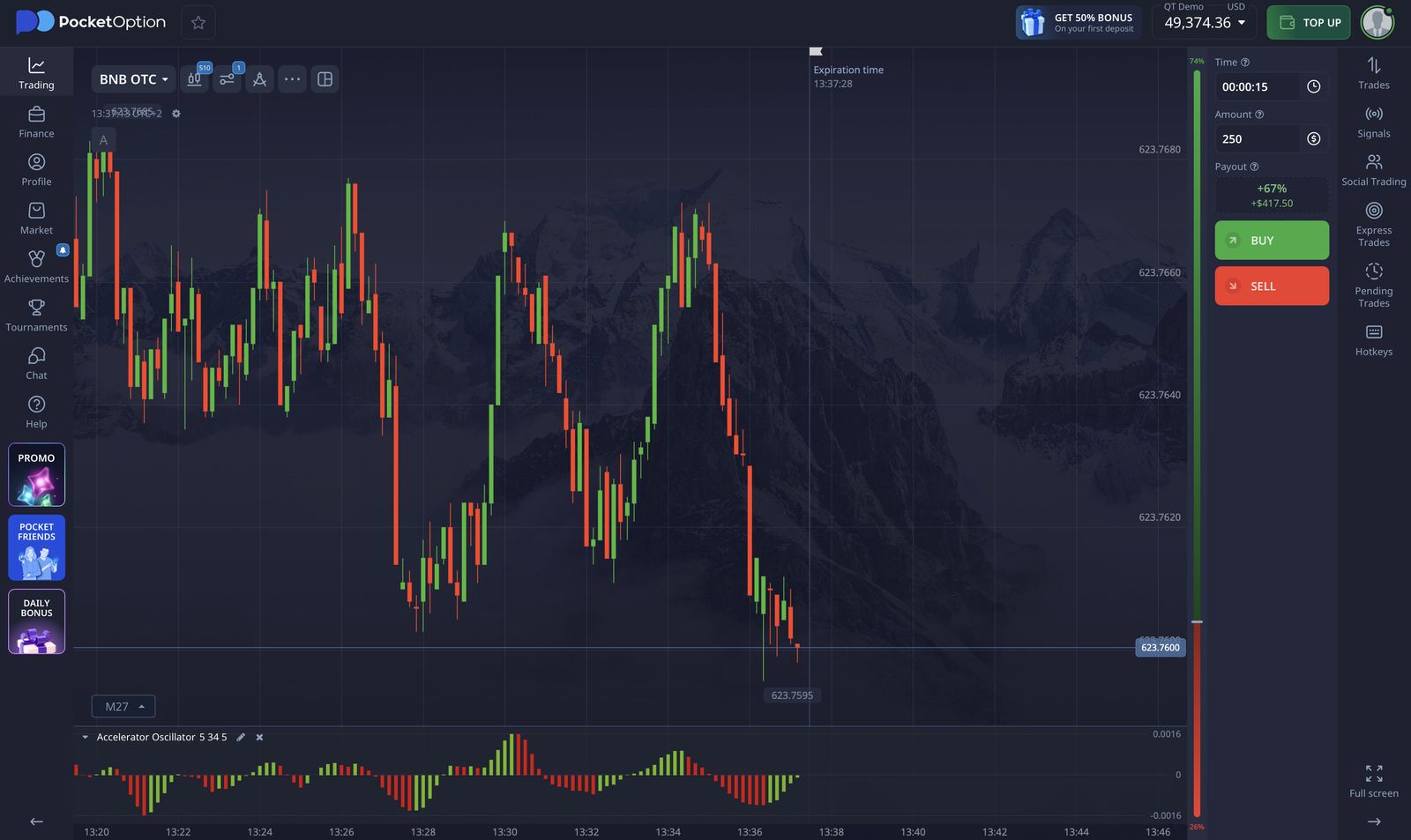
On Pocket Option this happens in quick trading mode, where you pick a duration and the trade closes after that many seconds or minutes. Third-party reviews disagree on the exact minimum expiry and which assets allow the very shortest durations, so check the expiry menu on the asset you want. If you are searching for a "Pocket Option 5 second strategy", start by confirming that the asset you plan to trade offers 5-second expiry at all.
Why very short expiries are mostly noise
Price moves over a few seconds are driven by individual orders, quote updates and rounding, not by trends or news. The amount a price can be expected to move grows with the square root of time. Here is a rough illustration for EUR/USD at about 1.10, assuming 8% annualised volatility (a typical calm-market level; real volatility varies):
| Expiry | Typical one-standard-deviation move |
|---|---|
| 5 seconds | about 0.4 pips |
| 30 seconds | about 1.0 pip |
| 1 minute | about 1.5 pips |
| 2 minutes | about 2.1 pips |
| 3 minutes | about 2.5 pips |
| 5 minutes | about 3.3 pips |
| 15 minutes | about 5.7 pips |
Calculation: move ≈ price × volatility × √(t ÷ seconds in a trading year), using 252 days × 24 hours. These are illustrations, not forecasts.
Over 5 seconds, the typical move is smaller than a pip. That is the same order of size as a bid-ask spread on many feeds, a single quote refresh, or the delay between your click and the platform registering the trade. When the thing you are predicting is smaller than the noise in how the price is measured, no indicator can reliably tell you the direction.
Note: An indicator such as RSI or Bollinger Bands calculated on 5-second candles is still built from noise. It will produce signals; they will just not mean much. See the RSI guide for how indicators behave on different timeframes.
Latency and the strike price
In a fixed-time trade your strike is the price the platform records when your order arrives. With 5-second expiries, a few hundred milliseconds of delay can shift the strike by a meaningful fraction of the expected move. You do not control that delay, and you cannot audit it. At 5-minute expiries the same delay is negligible.
OTC feeds make it worse
Many of the shortest-expiry trades happen on OTC assets, whose prices are generated by the broker outside market hours (see Pocket Option OTC). A 5-second trade on a broker-generated feed means predicting tiny moves in a price series you cannot check against any market.
The expected-value arithmetic
Every trade has an expected value (EV) per $1 staked:
EV = (win rate × payout) − (loss rate × 1)
With a 50% win rate, which is what you should expect if short-term moves are random:
| Payout | Break-even win rate | EV per $1 at 50% wins | EV per $10 trade |
|---|---|---|---|
| 92% | 52.1% | −$0.04 | −$0.40 |
| 85% | 54.1% | −$0.075 | −$0.75 |
| 80% | 55.6% | −$0.10 | −$1.00 |
| 70% | 58.8% | −$0.15 | −$1.50 |
Losing 40 cents on a $10 trade looks small. Short expiries multiply it.
How the number of trades changes the outcome
We computed the exact probability of being in profit after n trades, using the binomial distribution, for a trader who wins 50% of the time:
| Trades | Expected result ($10 stakes, 92% payout) | Chance of being in profit at 92% | at 85% | at 80% |
|---|---|---|---|---|
| 20 | −$8 | 41% | 41% | 25% |
| 100 | −$40 | 31% | 18% | 14% |
| 500 | −$200 | 17% | 3% | 0.7% |
| 1,000 | −$400 | 10% | 0.5% | ~0% |
This is the core problem with a 5-second or 30-second strategy. A few lucky sessions are common, which is why short-expiry "proof" videos are easy to make. Over a few hundred trades, which you can reach in a single day at these speeds, the small negative EV dominates.
Now look at a trader with a real but modest edge, winning 53% at a 92% payout. EV is +$0.018 per $1. After 1,000 trades the chance of being in profit is about 73%. At an 85% payout the same 53% win rate is still negative (EV −$0.02). A real edge has to be bigger than the gap between 50% and your break-even rate, and you have to prove it over hundreds of trades. Run your own numbers in the expected value calculator.
Example: You take 200 trades of $5 in an evening on 30-second expiries at an 85% payout, winning 52% of them. Wins: 104 × $4.25 = $442. Losses: 96 × $5 = $480. Net: −$38, even though you won more trades than you lost.
Overtrading: the hidden cost of quick trading
Short expiries change behaviour as much as maths:
- No time to think. A 30-second trade ends before you can review it, so the next click comes from emotion.
- Loss chasing. A string of quick losses invites doubling up. See why martingale fails.
- Fatigue. Hundreds of decisions in an hour degrade judgement.
- Inflated turnover. Bonus turnover requirements are met fastest with rapid trades, which is one reason platforms promote them.
Read overtrading for practical limits.
If you still want to trade short expiries
Prefer 1–5 minutes over seconds
A Pocket Option 1 minute strategy or a 5 min strategy at least operates where the typical move is larger than the noise in the quote. These timeframes also let you use support and resistance from higher charts. Our guide on how to choose expiry time explains how to match expiry to the chart you analyse.
A framework for a 1–5 minute approach
- Analyse on a higher timeframe. Mark levels on the 5- or 15-minute chart; use the 1-minute chart only for timing.
- Trade only during active market hours on market (non-OTC) assets, so the price is verifiable. See best time to trade binary options.
- Set an expiry at least 2–3 candles long relative to your entry chart.
- Pre-define a daily trade cap, for example 10–15 trades, and a daily loss limit.
- Choose assets with the highest payout at that moment; every point of payout lowers your break-even.
- Journal every trade with expiry, asset, payout and reason.
Test before you risk money
Run at least 100–200 demo trades with exactly the rules you plan to use, then calculate your win rate and EV. If you are not clearly above break-even, the strategy does not work, regardless of how convincing a single session felt. You can open a free Pocket Option demo to do this without risk.
Risk warning: Binary options are high-risk and most retail traders lose money. Short expiries increase the number of trades and the speed of losses.
FAQ
Does a binary options 30 second strategy work?
We know of no verified evidence that any 30-second strategy beats the built-in edge over a large number of trades. Price moves over 30 seconds are small relative to quote noise and latency, so expect results close to a coin flip, which loses money at payouts below 100%.
What is the best Pocket Option 5 second strategy?
There is no reliable one. Typical 5-second moves are smaller than a pip on major forex pairs, and outcomes are driven by tick noise and execution delay. If you want short trades, move to 1–5 minute expiries and prove a win rate above break-even on demo.
Is the 1 minute timeframe good for binary options?
It is better than seconds but still noisy. Use the 1-minute chart for timing and a higher timeframe for direction, and keep expiries to at least 2–3 minutes where possible.
Is a 5 min strategy better than a 2 minute or 3 minute strategy?
Longer expiries give the price more room to move relative to noise and let you use higher-timeframe analysis. They also limit how many trades you can take, which reduces overtrading. Neither guarantees profit; only your tested win rate versus the payout decides that.
Key takeaways
- At very short expiries (3–30 seconds) price moves are often smaller than spread, quote refresh and latency effects.
- At a 50% win rate every payout below 100% has negative EV: −$0.04 to −$0.15 per $1.
- Short expiries multiply trade count; at an 85% payout a coin-flip trader has about a 3% chance of being ahead after 500 trades.
- If you trade short, prefer 1–5 minute expiries on market assets during active hours.
- Prove any strategy with 100–200 demo trades and a journal before using real money.

Recommended broker
Practise this on a free Pocket Option demo
Free demo account, $1 minimum trade and payouts up to 92%. Test everything with virtual money first.
Binary options are high risk and not available in every country. Check the legal status where you live.
This guide is for educational purposes only and is not financial advice. Binary options are high risk and banned for retail clients in many countries. See our risk disclaimer.
Keep learning
How to Start Trading Binary Options: A Step-by-Step Plan for Beginners
How to start trading binary options step by step: check legality, learn the payout math, practise on demo, pick a broker and size your first real trades.
8 min read · 6 Aug 2026Practical GuidesHow to Use a Binary Options Demo Account (So the Practice Actually Counts)
How to use a binary options demo account properly: set a realistic balance, trade written rules, log 100+ trades and judge results against break-even.
7 min read · 9 Aug 2026Practical GuidesHow to Choose Expiry Time in Binary Options
How to choose expiry time in binary options: match expiry to your chart time frame and setup, avoid ultra-short trades and test choices on a demo first.
7 min read · 23 Aug 2026